Understanding tree care
Discover every facet of the arborist's profession: one that combines technique, know-how and respect for nature.
Chapter 01
Trees and pruning
Trees are living, organised and structured beings, living in symbiosis with the species around them. They grow to spread their foliage and capture as much sunlight — essential to their growth — as possible, and they are not the only ones to benefit from it. Besides sheltering the wildlife around them, they return nearly 70% of the carbon mass they produce to the soil.
of the carbon mass a tree produces goes back to the soil.
However, their growth and size can sometimes disrupt this coexistence. These nuisances can be of many kinds (lack of space, appearance, lack of light, fear of a weakness threatening a potential target) and may require an arborist's intervention to help resolve a situation that bothers people.
Tree care was born from human needs. The profession is relatively recent (early 1900s), as are the advances in dendrobiology, which have only recommended "reasoned" pruning since the early 1980s.
"Reasoned pruning", often confused with "gentle pruning" — itself the opposite of "drastic pruning" — always follows a process of diagnosis and relevant recommendations for a given context. It doesn't just minimise cut diameters; it also seeks to reduce their number and impact by limiting them to targeted areas of the tree.
Early 1900s
Tree care is born from human needs.
Early 1980s
Dendrobiology recommends "reasoned" pruning.
Today
An individual assessment of each tree, minimal and targeted cuts.
Since every tree is unique, the arborist will propose appropriate pruning after carrying out an individual, personalised diagnosis of each tree. Yet in the interest of the tree — which, let's remember, does not need the intervention — let's keep this essential rule in mind: "Severe pruning seriously harms the health and beauty of your trees."
This is the outlook and approach with which I intend to work on your trees: while an arborist's intervention is sometimes essential to people's comfort, it is still carried out on a living being, part of an ecosystem that is fragile yet essential to life.
Some practices, unfortunately all too common, should be avoided because they meet neither the tree's needs nor the client's: in the medium term they create other problems, or even the opposite of the intended result.
Topping, for example, which aims to reduce a tree's height so it won't fall on a roof or elsewhere, will end in felling in the medium term.
If the tree is vigorous enough, it will quickly regain its original height, but with much weaker replacement shoots, creating breakage risks that did not exist before.
If it lacks vigour, it will not regrow. Either way, the risk of pathogens entering through the wounds left by the cuts will be high, again increasing the risk of losing the tree entirely.
Topping
Weak regrowth, breaking branches, a tree in decline.
Reasoned pruning
Targeted, minimal cuts: the tree stays healthy and beautiful.
The constant progress of knowledge in dendrobiology requires paying close attention to field observations and results, and daring to question practices that are nonetheless common. Ongoing learning and training is also needed to apply the right methods.
With this knowledge, and to preserve your trees' health, I refuse to use certain methods and will strive to bring you a more suitable solution. In the same spirit, I stay in close contact with the SFA (French Arboriculture Society), the CFPPA in Antibes and their trainers, to keep up with the latest discoveries and working methods.
Chapter 02
Common misconceptions
A few misconceptions that harm your trees — and that some arborists use as sales arguments.
Misconception"Pruning a tree rejuvenates it"Why?
The quick, visible "regrowth" of branches and leaves is not caused by a "rejuvenation" brought on by pruning. It is one of the mechanisms a tree uses after a wound or stress to rebuild the leaf mass it has lost. That leaf mass is essential to turn raw sap into elaborated sap through photosynthesis, which happens in the leaves!
This "regrowth" response depends on several key factors:
- the tree's physiological condition;
- its species: not all species grow replacement branches;
- its vigour and carbon reserves;
- the quality of the pruning.
Using up these reserves can also harm the tree if it later faces other attacks or stresses.
Misconception"Arborists heal trees"Why?
By what miracle could climbing a tree armed with a saw and a chainsaw (sometimes even with spikes on one's boots) heal anything? Just as amputating a limb doesn't cure a person, cutting a branch may sometimes stop something from spreading, but in most cases it only creates a wound — a potential entry point for pathogens.
So keep in mind that pruning, whatever the reason, should be as minimal as possible if the goal is to keep the tree. An arborist should not be judged on how many branches and how much wood they remove.
Misconception"The tree is leaning, it's dangerous, it must be felled"Why?
A leaning tree is not necessarily dangerous. A lean or curve that formed throughout its growth is in no way a sign of danger: all trees can adapt to it and build reinforcement wood as they grow. Some, like conifers, form compression wood under the lean, supporting the tree like a prop, while broadleaved trees prefer tension wood, holding it back like a guy rope.
A tree's lean may, however, be very recent. Even then the danger is not necessarily real, and it's worth asking the right questions:
- What is causing the lean? How fast is it changing?
- Will it get worse?
- Does the tree have the ability (and the time) to adapt?
- Would its fall really be dangerous? (How likely is a fragile, high-value target to be there at the moment it falls?)
- Is there another solution than felling?
Misconception"Hollow trees are dangerous"Why?
Again, not all hollow trees are dangerous; many factors have to be considered:
- Is there enough residual wood and reinforcement wood around the weak area?
- Is its exposure and wind load high enough to suggest it could fail?
- And again, would its fall really be dangerous?
A hollow tree with very little residual wood, even without reinforcement, whose crown is not exposed to the wind — either because it is small or sheltered by other trees — can easily stand for more than a human lifetime. Just as a tree that looks healthy can fall without warning when exposed to a wind blowing against the prevailing winds it grew accustomed to.
Misconception"Pruning a tree reduces its wind load and limits breakage"Why?
We tend to see a tree's crown as a big sail that the wind fills until it breaks. But leaves (or needles) and branches, from the smallest to the largest, act more like thousands of little shock absorbers, each deflecting and absorbing a small amount of wind, splitting its force and therefore the risk of damage. A tree pruned too severely will be exposed to the strongest winds acting directly on its bare, least flexible branches. Given time, it will regrow its foliage, but the replacement shoots that appear after such pruning will take years — if they ever manage — to become as strong as the branches they replace.
Misconception"Severe pruning means coming back less often"Why?
Once again, if pruning is too severe, the tree will try to replace its foliage as fast as possible. Replacement shoots grow more chaotically, trying to regain their length and foliage, very quickly restoring the tree's original volume without the strength of the original branches. By favouring light but targeted pruning, while letting the tree evolve, it won't need to renew the removed branches, avoiding another intervention. The result: one small intervention, limited risk for the tree and a more economical solution in the long run.
In short, let's be wary of these misconceptions and rely on science and its progress to protect our tree heritage. Let's respect our trees — they give us so much back.
Chapter 03
Safety
Safety is of paramount importance in our work and covers many points of vigilance. You don't want to see an arborist damage your property or your trees, let alone injure a passer-by, another worker, himself or a member of your family.
An arborist must therefore be beyond reproach when it comes to safety and use every means at his disposal to achieve it. On a first visit, he must check how the tree can be accessed. Is the tree fit to be climbed? If not, can it be reached from another nearby tree? Can an aerial lift be brought in?
Next: what surrounding elements need protecting? (Roofs, roads, verandas, footpaths, plantings, etc.) Their location may require complex techniques set up by the ground worker (rigging and lowering, zip lines, pulley systems, etc.).
The ground worker must not be a mere labourer but trained in these techniques as well as in aerial rescue, so he can assist the climber if needed. He must also be able to operate equipment such as a wood chipper, sometimes very large and powerful.
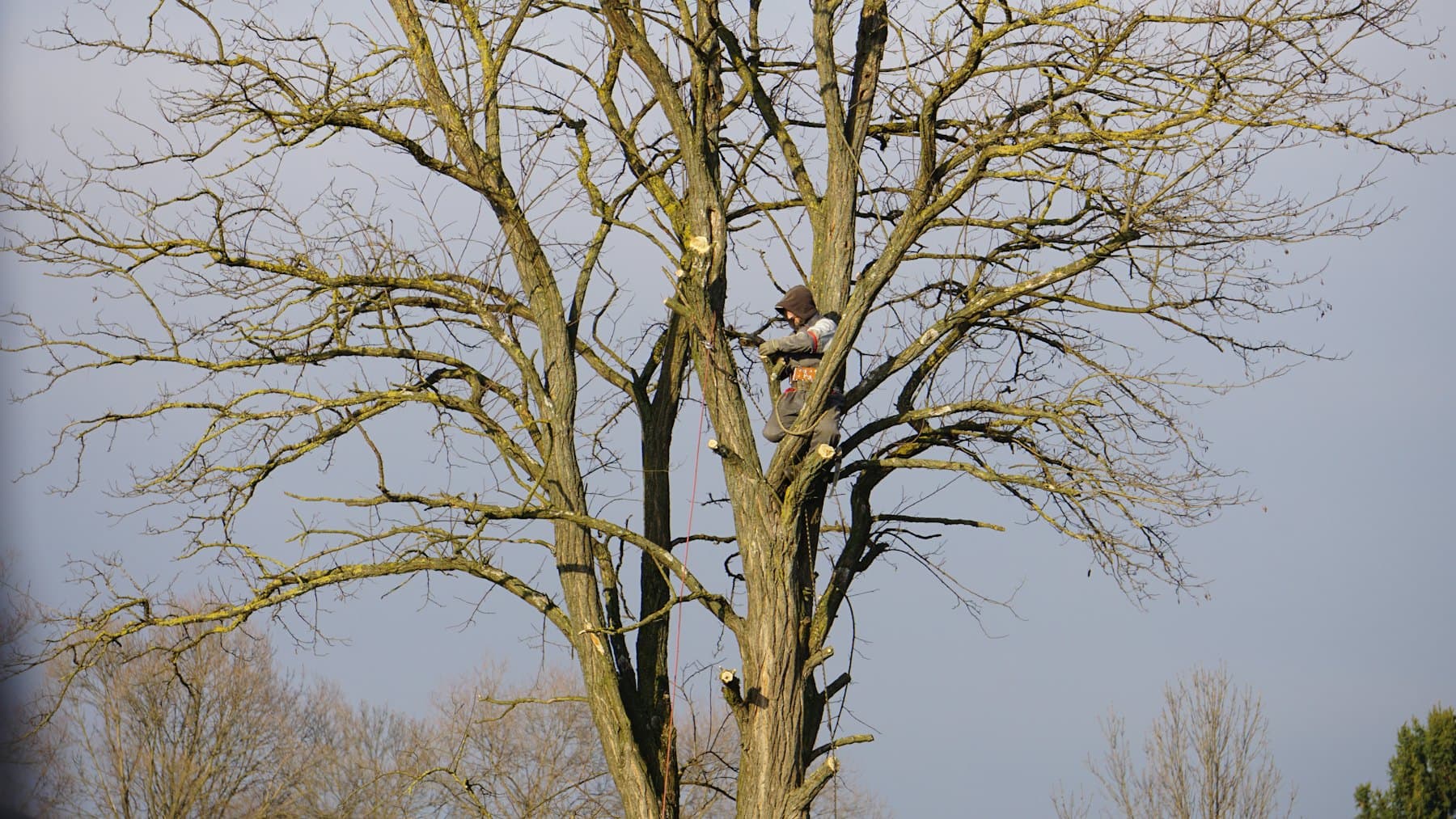
The climber is responsible for all the points above, before and during the work — on top of his own safety. He must use techniques to prevent falls, such as double anchoring when using cutting tools. He must check his position so he is never under the cut, and make sure nothing and no one is in the drop zone. He must use his tools in a position that doesn't put him in danger.
To prepare for injury, he must also be able to get down to the ground quickly at all times. At the end of the job, all cut material must be cleared and no cut branch left hanging that could fall later.
Despite all these precautions, tree work remains one of the most dangerous professions. That's why it is essential to keep up with developments in equipment and techniques. As with knowledge of trees, I believe it's important to keep training, which is why I stay in close contact with the trainers of the CFPPA and with the SFA.
Anyone who hires a professional expects the work to be done without accidents — because, as everyone knows, whoever complains about a professional's price has no idea what an incompetent one can cost.